
Social skills are essential building blocks for connection, communication, and confidence—but many children with autism need extra support to develop them. For Jupiter and Palm Beach families, the home is one of the most powerful environments for nurturing these skills. With the right activities, structure, and consistency, parents can help their children strengthen social interactions in ways that feel natural and enjoyable.
This guide explores simple, evidence-based social skills activities for children with autism at home, how parents can build meaningful interactions, and why early, consistent practice matters. The strategies below are inspired by leading autism therapy organizations and child development research.
Why Social Skills Practice Matters at Home
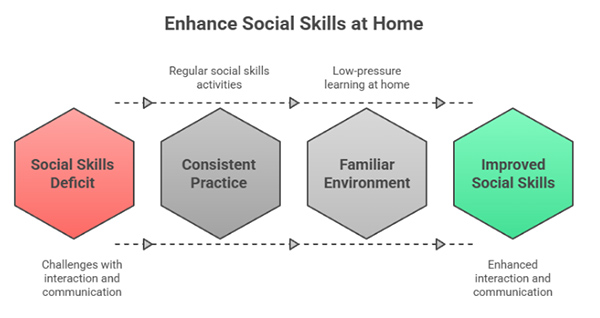
Home-based social skills activities help children generalize what they learn in therapy into real-life settings—where they spend much of their time. Research shows:
- Children on the autism spectrum may have challenges with peer interaction, communication, and shared attention(ScienceDirect, 2011).
- Social-skills intervention leads to measurable improvements in eye contact, turn-taking, emotional understanding, and conversation(PMC, 2021).
- Consistent social practice at home can enhance school readiness, support family relationships, and reduce behavioral frustration.
For families in Jupiter, Palm Beach, and surrounding areas, practicing social skills at home allows children to learn in a familiar, low-pressure environment—making progress feel attainable and even fun.
Common Social Challenges in Autistic Children
According to the American Academy of Pediatrics and autism behavioral experts, children with autism may experience:
1. Difficulties with Communication
- Limited conversational turn-taking
- Delayed or literal language
- Difficulty understanding gestures, tone, or facial expressions
2. Challenges with Social Engagement
- Preferring solitary play
- Inconsistent responses to social cues
- Difficulty initiating or sustaining interaction with peers or siblings
3. Repetition and Predictability
- Strong reliance on routines
- Repetitive play patterns
- Difficulty adapting to new games or changes in play
4. Sensory Sensitivities
- Over- or under-reactivity to sound, touch, or movement
- Challenges with activities that involve multiple sensory inputs
Understanding these challenges helps parents choose appropriate social skills activities that match their child’s developmental stage.
Social Skills Building Activities for Children With Autism at Home
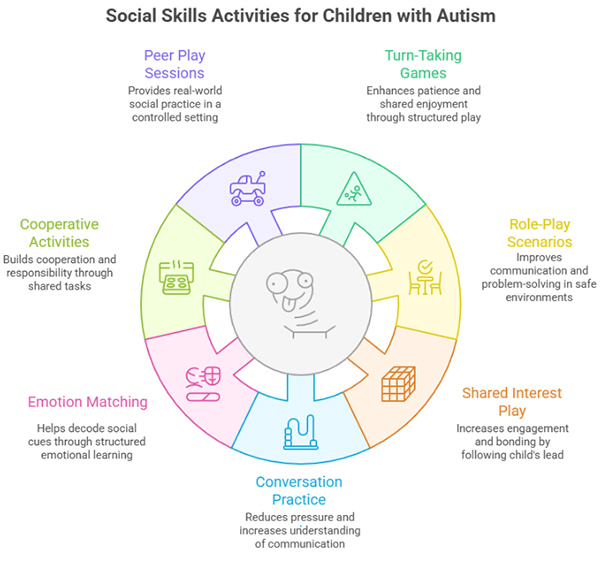
Below are practical, therapist-endorsed home activities that build interaction, communication, and confidence.
- Turn-Taking Games
Turn-taking is one of the foundational social skills. Simple activities such as:
- Rolling a ball back and forth
- Taking turns placing blocks in a tower
- Turn-based board games like “Candy Land” or “Connect 4”
These activities improve waiting, patience, shared enjoyment, and predictability—all essential for social development.
Why it works:
Turn-taking teaches reciprocity, helps children connect action with response, and reinforces the idea of “your turn, my turn.”
- Role-Play Scenarios
Role-play allows children to practice real-life situations in a safe, playful way. Try:
- Practicing greetings (“Hi,” “Bye,” “How are you?”)
- Pretend play shopping or restaurant scenarios
- Role-playing emotions (happy, sad, tired, excited)
Why it works:
Role-play strengthens communication and social problem-solving and prepares children for interactions outside the home.
- Shared Interest Play
Instead of leading the activity, parents follow the child’s interests:
- Playing with the child’s favorite toy
- Joining their preferred game
- Expanding the play slightly (e.g., adding characters, making simple storylines)
Why it works:
According to autism therapists, child-led play increases engagement and strengthens bonding.
- Conversation Practice with Visual Supports
Visuals help children understand the flow of conversation. You can use:
- Picture cards
- Emotion cards
- Simple “question–answer” flashcards
- Feelings charts
Practice prompts like:
- “What did you play today?”
- “What makes you happy?”
- “Which game do you want?”
Why it works:
Visual supports reduce pressure and increase understanding of communication patterns.
- Emotion Matching Activities
Use picture books, facial expression cards, or mirrors to help your child:
- Identify emotions
- Label feelings
- Recognize expressions in others
Why it works:
Children with autism often benefit from structured emotional learning to decode social cues.
- Cooperative Household Activities
Everyday tasks offer natural social-learning moments:
- Cooking together
- Sorting laundry
- Watering plants
- Feeding pets
Why it works:
Shared tasks build cooperation, responsibility, and back-and-forth interaction.
- Peer or Sibling Play Sessions
Guided interactions with siblings or peers help children practice:
- Sharing
- Collaborative play
- Expressing needs
- Negotiating and problem-solving
Why it works:
Peer interactions provide real-world social practice in a safe, controlled setting.
How Jupiter Parents Can Support Consistent Progress
1. Start Small and Build Up
Short 5–10-minute sessions can be just as effective as longer structured activities.
2. Celebrate Small Wins
Positive reinforcement boosts motivation and confidence.
3. Use Visual Schedules
Create a simple chart showing the activity sequence.
4. Keep Activities Predictable
Children with autism thrive with consistency and routine.
5. Track Progress Weekly
A simple notebook or digital chart helps parents notice growth over time.
Call to Action
If you’re a parent in Jupiter, Palm Beach, or the Treasure Coast looking to support your child’s social development at home, you’re not alone—and you don’t have to guide this journey by yourself.
Dr. Priti Kothari specializes in autism evaluation, early childhood development, social-skills support, and individualized parent guidance.
 Serving Jupiter, Palm Beach, and surrounding Florida communities
 Learn more or schedule an appointment:
https://www.drpritikothari.com/
Every step counts—let’s build your child’s social confidence together.
References
- Max Healthcare (2023). Autism and Social Skills.
https://www.maxhealthcare.in/blogs/autism-and-social-skills - Lighthouse Autism Center (2023). Games and Activities for Children with Autism.
https://lighthouseautismcenter.com/blog/games-activities-children-autism-aspergers-sensory-processing-disorders/ - Rise Up for Autism (2023). Activities for Autism at Home.
https://riseupforautism.com/blog/activities-for-autism-at-home - TalkToAngel (2024). Ways to Improve Social Skills in Autistic Children.
https://www.talktoangel.com/blog/ways-to-improve-social-skills-in-autistic-children - Behavioral Innovations (2024). Therapeutic Activities for Parents to Incorporate at Home.https://behavioral-innovations.com/blog/beneficial-therapeutic-activities-for-parents-child-with-autism-incorporate-at-home
- Pebbles Therapy Centre (2023). Social Skills Training for Kids with Autism.
https://pebblestherapycentre.in/blog/social-skills-training-for-kids-with-autism-strategies/ - Encore Support (2024). Practical Social Skills Home Activities.
https://encoresupport.org/practical-social-skills-activities-you-can-try-at-home/ - Autism Therapies (2024). Games and Activities for Social Skills at Home.
https://autismtherapies.com/blog/games-and-activities-to-practice-social-skills-at-home - Positive Action (2023). Social Skills Activities and Games for Kids.
https://www.positiveaction.net/blog/social-skills-activities-and-games-for-kids - Twisha Mpati (2023). Best Ways to Engage an Autistic Child at Home.
https://www.drtwishampati.com/blog/best-ways-to-engage-an-autistic-child-at-home